

February may be the shortest month of the year, but it can feel like the longest. Winter is beginning to outstay its welcome, and we are all eager to get on with Spring.
There are, however, some flowers that brighten up the gloom just as the season shifts from deepest winter to early spring. Not only do late winter blooms provide all-important food for insects when little else is available, their colour and beauty light up the monochrome February border, representing new beginnings, significantly lifting our spirits and filling us with optimism.
What could be more quintessentially British than snowdrops, primroses and hellebores? Often shrouded in mystery and used in herbalism, these old favourites are the stuff of legend.

Fair Maids of February
Possibly the most iconic of all late winter flowers is Galanthus nivalis, or the snowdrop. Brought to Britain by the ancient Romans, its botanical name literally translates to Milk Flower of the Snow. Candlemas Bells is another traditional name for the snowdrop, because it flowers around February 2nd, the feast day of Candlemas. Other colloquial names include Fair Maids of February, White Ladies and Snow Lily, although there is no relation to the lily.
Snowdrops attract some seriously obsessive collectors, called galanthophiles, who often seek out rare varieties and study the minute differences between cultivars. In fact, in 2022, a single bulb of a rare variety sold on the internet for £1850.
A Moldovan legend describes a fight between Winter Witch and Lady Spring. The cycle of the seasons is depicted by Winter Witch as she battles to hold onto winter, but is overcome by the warmth radiating from Lady Spring. During the struggle, Lady Spring cuts her finger. Where a drop of her blood melted the snow, a snowdrop flower grew. The pure white flower signified Lady Spring’s victory over the Winter Witch, heralding the change of the season. Winter Witch represents endings and the wisdom in letting go. Lady Spring signifies hope, new beginnings, renewal and the cycle of life.

According to hearsay, snowdrops can generate their own heat, although there is no evidence to corroborate this! But there is a dark side to snowdrops. Bringing a snowdrop indoors, the milk will turn sour, and eggs shall spoil. Worse still, according to Victorian superstition, if you bring them into the house, they will bring bad luck, heralding a death in the family within the year!
The Primrose Path
Primula vulgaris, or the common primrose, is a British native wildflower, found in woodlands, hedgerows and grasslands. Known as Fairy Cups, due to its many links to the fairies, the primrose has a myriad of colloquial names, from cowslip to herb peter, peggle, key flower and arthritica.
The young leaves and flowers of the wild primula vulgaris are considered safe for culinary use. They can be eaten raw in salads, cooked in soups and used to decorate cakes. I recently met a lady, easily in her 80s, who remembers her mother making primrose wine. She would be sent out by her mother to collect the flowers and told not to come back until the pint jug was full.
In ancient Greece and Rome, and throughout the medieval period, the whole plant and especially the root were considered to have analgesic, antispasmodic, diuretic and expectorant properties! Historically, primrose was given for headaches and colds, so it’s no surprise then to learn that primula contains natural chemical compounds closely related to salicylic acid, the active ingredient in aspirin.
If you’ve ever wondered where the phrase the primrose path comes from – and haven’t we all – look no further. The original reference can be found in Shakespeare‘s Hamlet, ‘the primrose path of dalliance’, a path strewn with flowers representing the thoughtless pursuit of pleasure, especially when it is seen to bring disastrous consequences.
There is a charming German tale of a young girl who chanced upon a doorway covered in flowers. She touched the door with a primrose, and it opened to reveal a fairy castle. It’s hard to put a date on the origins of these myths as they predate written records, but certainly from medieval times onwards, the primrose became known as the Key Flower. In Norse legend, a bunch of keys, found amongst the flowers, was thought to be the keys to the Goddess Freya’s treasure palace, she being the Key Virgin.
For centuries, throughout the British Isles, the primrose was considered a symbol of safety and protection. Primroses placed on a doorstep would encourage the fairies to bless the house and its occupants and shield them from harm. But if you are thinking of bringing a posy of primroses into the house, count them carefully. Any more or less than 13 can bring you bad luck.

According to Scottish legend, if you ate primrose flowers, you would see a fairy. In rural Ireland, our farming forebears placed primroses in their cowsheds to convince the fairies not to steal the milk. They also rubbed primroses on their cows’ udders at Bealtane, the ancient Gaelic May Day festival, to promote good milk production in their cows. Perhaps that’s how the cowslip got its name.
The Oracle Rose
Hellebore’s beauty in winter, when most flowers are dormant, has made it a symbol of resilience and hope. Yet, its poisonous nature reminds us that beauty can have a hidden edge. In the Victorian language of flowers, the hellebore was sometimes associated with delirium, and sending or receiving a hellebore was often interpreted as a sign of madness.
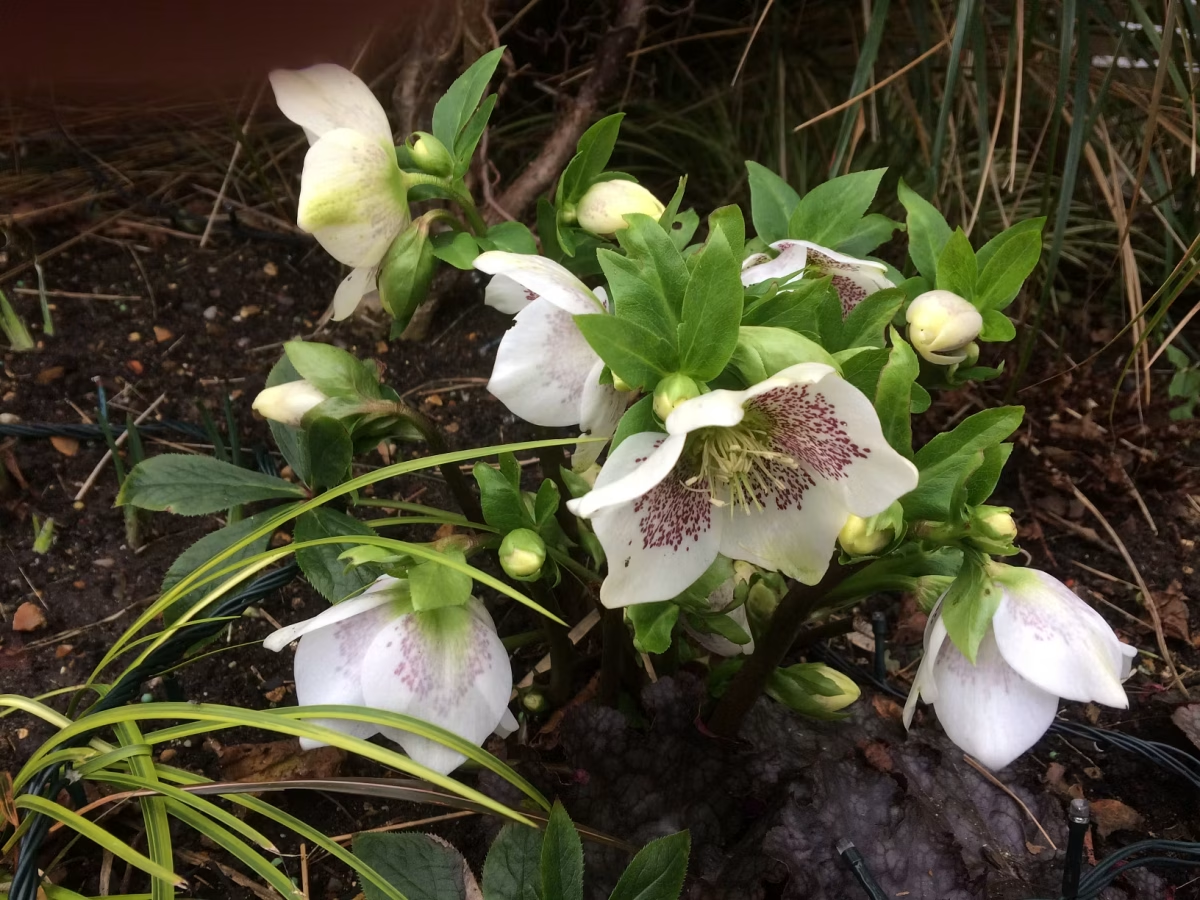
The hellebore is often referred to as the Christmas or Lenten Rose, as it blooms between December and February, often holding onto its flowers right through Lent. Legend has it that a poor shepherd girl called Madelon wept as she travelled to Bethlehem to see the baby Jesus, because she did not have a gift for him. Where her tears fell to the ground, a beautiful white hellebore sprang out of the soil, and she was overjoyed to be able to present Him with her Christmas Rose. There is, however, no connection between hellebores and roses!
Hellebore was also known as Sneezewort, because it would induce sneezing if ground to a fine powder. In medieval times, witches were believed to spread the fine powder on the ground to make themselves invisible. French folklore tells of a sorcerer who utilised his powers of invisibility to move about unseen through enemy lines by throwing the powdered plant in the air surrounding him. It was a key ingredient in curses and spells, used in rites of exorcism, banishment and protection.
Another less common name for hellebore is the Oracle Rose, so-called after the ancient practice of using hellebores to forecast the weather for the following year. In rural areas before Christmas, it was traditional to pick twelve hellebore buds, placing each bud in a separate glass of water, assigning one bud to each month. If a bud came into flower by Christmas Eve, the weather was predicted to be good for that corresponding month. If it did not open, poor weather was to be expected.
So, the next time you take a woodland walk, be sure to watch where you tread.
There may be fairies hiding amongst the flowers, and you wouldn’t want to upset them now, would you!


